

The relations we have with AI
Do you know what the No. 1 use case of AI is among users? I have encountered this question a couple of times in my own research, in AI talks that I attend, and in news reporting. Perhaps you have heard of this as well. Research showed that companionship and therapy have been the top AI use in both 2025 and 2026 (Zao-Sanders, 2026). This may be surprising to many, as much of today's discussion has centered on the functions and features of AI. However, AI is increasingly shaping human relationships and emerging as a distinct form of relationship in human life. When it comes to such relationships, the stakes are higher, and the opinions remain divided.

Ben Shneiderman, a computer scientist and a leader in the field of computer-human interaction (HCI), runs the Google Group “Human-Centered AI”. In the group’s 158th NOTE, he cautioned against framing AI as collaborators, teammates, or partners. He argued that AI should be portrayed as tools since they can’t take moral and legal responsibilities as humans do. This point was part of his exchange with Meredith Ringel Morris, another computer scientist in HCI, who responded that, despite various arguments on whether AI can genuinely hold those relational roles, subjective experiences of users matter, and hundreds of millions are feeling as if having those relationships with AI, although they don't necessarily consider AI the same as people.
At first, this may appear to be a debate, but it is better understood as two sides of the same problem: how AI tools are framed by designers and how users perceive those tools are distinct but deeply intertwined questions that shape and reinforce one another. Despite the many labels used to describe AI, partly because of cognitive and affective biases, humans naturally tend to project human-like traits onto AI or apply human relational frameworks to understand it (Saracini et al., 2025). As the classic Computers as Social Actors (CASA) paradigm suggests, people often respond to computers as social actors and apply the same social rules in their interactions with machines (Nass et al., 1994). At the same time, humans have long formed relationships with, and acquired knowledge from, other non-humans such as animals, trees, and supernatural entities; AI can be viewed as a more recent form of non-human being with which humans are developing new forms of relation (Imafidon, 2026). In this sense, the conversations we have with AI, and the interaction habits we form, can spread to our social ties and gradually reshape how people think, speak, and allocate attention within the broader social fabric (Teixeira et al., 2026).
This brings us back to the central question: how should we understand AI’s role and our relation to it? Rather than adopting a dualistic view, in which humans and AI are separate and opposing forces, we should recognize that they increasingly coexist and shape one another (Follows, 2026). The task is, then, not to decide whether AI is merely a tool or relational entity, but to consciously navigate this dual role and actively shape forms of human-AI relation that benefit both individuals and society.

By: Jin Chen, PhD
Affiliate Fellow
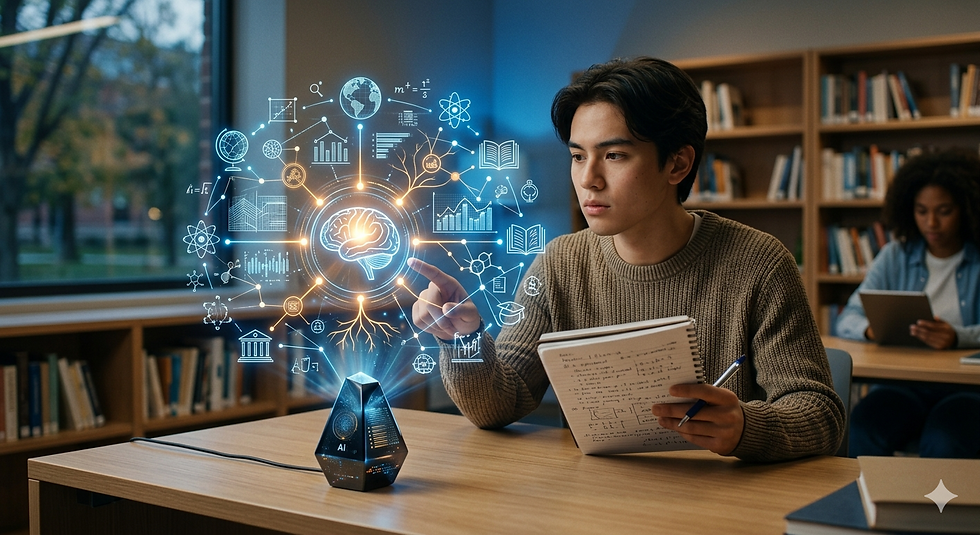
AI Disclosure: ChatGPT 5.5 was used to proofread the author’s original draft and to generate the accompanying image.
References:
Follows, T. (2026, May 27). The unmachinable pope. LinkedIn. https://www.linkedin.com/pulse/unmachinable-pope-tracey-follows--d4xcf
Imafidon, E. (2026, May 27). AI begins and thrives with the humanities. SOAS University of London. https://www.soas.ac.uk/about/blogs/ai-begins-and-thrives-humanities
Nass, C., Steuer, J., & Tauber, E. R. (1994, April). Computers are social actors. In Proceedings of the SIGCHI conference on Human factors in computing systems (pp. 72-78). https://doi.org/10.1145/191666.191703
Saracini, C., Cornejo-Plaza, M. I., & Cippitani, R. (2025). Techno-emotional projection in human–GenAI relationships: A psychological and ethical conceptual perspective. Frontiers in Psychology, 16, 1662206. https://doi.org/10.3389/fpsyg.2025.1662206
Teixeira, A. S., Shergill, S. S., & Laban, G. (2026). Human–AI interactions reshape the self and our social networks. Nature Machine Intelligence. https://doi.org/10.1038/s42256-026-01248-2
Zao-Sanders, M. (2026, June 1). How people are really using AI in 2026. Harvard Business Review. https://hbr.org/2026/06/how-people-are-really-using-ai-in-2026

Comments