

Forget pre-testing. The future of Advertising might be the self-improving Ad. Thanks AI.


Advertising is entering a new era thanks to AI. Tools are no longer just assisting with targeting or copy generation. Increasingly, they are learning, adapting, and optimizing campaigns in real time. For advertising professionals, this raises an important question: what happens when ads are no longer static outputs, but self-improving systems? What does this mean for viewers?
Advertising Has Always Been About Attention
Any advertiser will tell you that advertising has always been about capturing attention. In a digital environment that increasingly resembles the pace and density of a New York rush hour, that goal has not changed. Ads are still trying to do what they have done for decades, which is to break through and be noticed (yes, and remememberd).
This challenge is not new. One of the earliest television advertisements, often cited in classrooms, was for Bulova watches in 1941. At the time, it was remarkable. A simple message delivered through a new medium was enough to stand out. Today, that same ad would likely disappear into a media environment defined by constant interruption and competing content streams.
The difference is scale. Today’s advertising landscape competes with social media feeds, streaming platforms, short-form video, and algorithmically curated content. In many cases, advertising is so integrated into these environments that it is not always immediately recognizable. Media literacy now requires the ability to identify persuasion, even when it blends seamlessly into content.
AI in Advertising: From A/B Testing to Continuous Optimization
Evaluation has long been central to this process. In mass communication, the early 2000s marked a shift toward more agile media strategies, where campaigns could be adjusted while in progress rather than evaluated only after completion. If you understand A/B testing, you understand the foundation of this approach.
AI extends this logic. What was once A versus B becomes something closer to:
[Original Ad Version + real-time feedback = (A₂ A₃ …) → continuous optimization]
(C) JJS 😊
Rather than testing a small number of variations, AI systems generate and evaluate many simultaneously, refining outputs continuously as new data emerges.
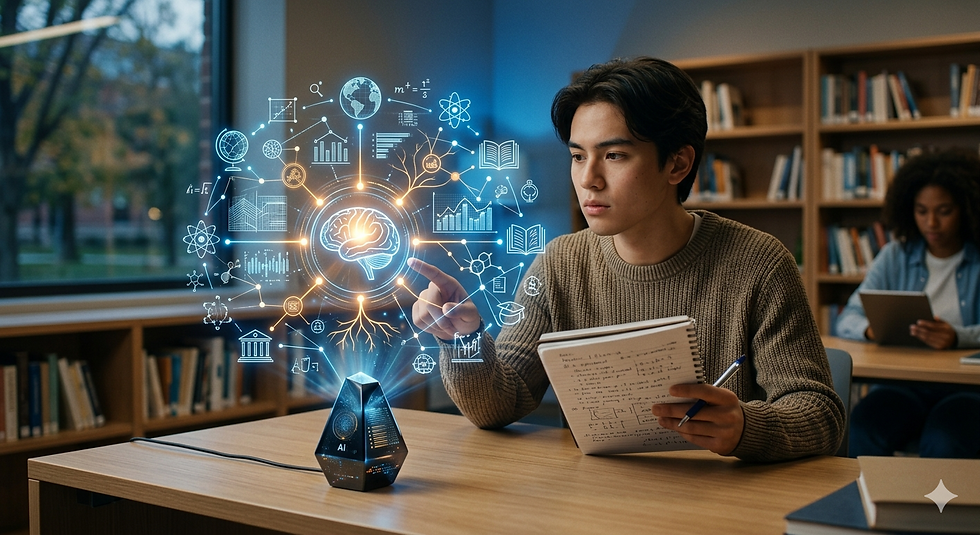
Against this backdrop, AI introduces a new possibility. Instead of relying on a fixed message to capture attention, advertisers can deploy systems that continuously adapt in response to audience behavior. Attention is no longer captured through a single execution, but through ongoing learning and refinement.
The Rise of Self-Improving Advertising
A growing number of platforms now reflect this shift. Rather than producing one campaign, AI systems generate multiple variations, test them simultaneously, and refine them based on performance data. Creative is no longer finalized at launch. It evolves. This hints at a broader transformation across the advertising as an industry. According to the Interactive Advertising Bureau (2025), AI is reshaping every stage of the process, from planning and buying to creative execution and measurement. It is not an added tool but an embedded system.
Industry data supports this shift. Research from Nielsen (2025) shows that marketers increasingly view AI-driven personalization as a defining change, with campaigns tailored at the individual level and adjusted in near real time. At the same time, the Marketing AI Institute (2025) finds that while adoption is widespread, strategic integration remains uneven. Translation: AI makes ads fit each person (think Minority Report), but not everyone uses this very well.
From an execution standpoint, AI is also reshaping advertising decision making. More complex data fed through AI now augments decisions about placement, audience, and creative. Companies such as Omneky are diving into machine learning to produce and refine ad creatives at scale, turning campaigns into continuous feedback loops. Better data means better refinement.
Taken together, these developments suggest a shift in how advertising should be conceptualized for future groups. Campaigns are becoming less like finished products and more like adaptive systems. Advertising used to be like printing a poster and hanging it up. Now it is more like a Spotify playlist that keeps changing based on what you skip or replay.
I find that many of these new AI workflow articles use fear mongering to drive up clicks. I'll be direct to ad folks who may still be reading, the role of the advertiser is not disappearing. It is shifting toward human-at-the center AI strategy, oversight, and system design. Let's recall the the World Economic Forum lists Creativeity and curiosity as a top skills over the next 10 years. That and, labor projections reinforce this trajectory. The U.S. Bureau of Labor Statistics estimates that employment in advertising and related fields will grow faster than average, with a projected increase of about 6% from 2024 to 2034. 👍
By: Joshua J. Smith, PhD
References
Interactive Advertising Bureau. (2025). State of data 2025: The evolving role of AI in digital advertising. https://www.iab.com/news/iab-state-of-data-report-2025/
Marketing AI Institute. (2025). 2025 state of marketing AI report. https://www.marketingaiinstitute.com/2025-state-of-marketing-ai-report
Nielsen. (2025). AI redefining marketing: Today and tomorrow. https://www.nielsen.com/insights/2025/ai-redefining-marketing-today-tomorrow/
AI Digital. (2025). 2025 media trends report: AI, data, and the future of advertising. https://www.aidigital.com/2025-media-trends-report
Omneky. (2024). AI-powered advertising platform overview. https://www.omneky.com/
Youtube. The first TV commercial: Bulova (1941) [Video]. https://www.youtube.com/watch?v=Fo8UnmFWK88
U.S. Bureau of Labor Statistics. (2024). Occupational outlook handbook: Advertising, promotions, and marketing managers. https://www.bls.gov/ooh/management/advertising-promotions-and-marketing-managers.htm
World Economic Forum. (2025). The future of jobs report 2025. https://www.weforum.org/publications/the-future-of-jobs-report-2025/
AI Disclosure
Portions of this post were developed with the assistance of generative AI to support drafting, organization, and editing. The author reviewed, revised, and verified all content, analysis, and sources to ensure accuracy and alignment with the cited materials.
Image credit: Gemini


Comments